
Instant switching between user accounts in WordPress and WooCommerce.

WP-UserOnline
Hospedagem WordPress com plugin WP-UserOnline
Onde hospedar o plugin WP-UserOnline?
Este plugin pode ser hospedado em qualquer servidor que tenha WordPress instalado. Recomendamos optar por uma empresa de hospedagem de confiança, com servidores otimizados para WordPress, como o serviço de hospedagem de sites da MCO2.
Hospedando o plugin WP-UserOnline em uma empresa de hospedagem confiável
A MCO2, além de configurar e instalar o WordPress na versão mais nova para seus clientes, fornece o WP SafePress, um sistema exclusivo que salvaguarda e otimiza seu site conjuntamente.
Por que a Hospedagem WordPress funciona melhor na MCO2?
A Hospedagem WordPress funciona melhor pois a MCO2 possui servidores otimizados para WordPress. A instalação de WordPress é diferente de uma instalação trivial, pois habilita imediatamente recursos como otimização de imagens, proteção da página de login, bloqueio de atividades suspeitas diretamente no firewall, cache avançado e HTTPS ativado por padrão. São recursos que potencializam seu WordPress para a máxima segurança e o máximo desempenho.
WP-UserOnline shows how many people are on your site right now, and where they are. Members are named, guests and search bots are counted, and the whole thing refreshes itself in the background without a page reload.
Features
- A counter, a “who is browsing this page” line and a “who is browsing the site” line, each usable on its own.
- A full users online page, listing every visitor with the page they are on, where they came from and when they arrived.
- A sidebar widget offering any of those five combinations.
- Every string is a template you can edit, so the wording is yours rather than the plugin’s.
- Around three hundred search bots recognised by user agent, and a filter for adding your own.
- One admin screen with three tabs — who is online now, the settings, the templates — plus a line in the Dashboard’s At a Glance panel.
- A section on the WP-Stats page when that plugin is installed.
Doações
Eu passo a maior parte do meu tempo livre na criação, atualização, manutenção e suporte desses plugins, se você realmente ama meus plugins e pode me enviar alguns dólares, eu realmente aprecio isso. Mas do contrário, sinta-se livre para usá-los sem quaisquer obrigações.
Usage
The simplest way is the widget. Go to WP-Admin -> Appearance -> Widgets, add the UserOnline widget to a sidebar, and pick which of the five statistics types it should show.
A classic theme can call the template tags directly instead, anywhere in sidebar.php, header.php or a template part:
<?php if ( function_exists( 'users_online' ) ) : ?>
    <p>Users online: <span id="useronline-count"><?php users_online(); ?></span></p>
<?php endif; ?>
The element ids matter: useronline-count, useronline-browsing-site, useronline-browsing-page and useronline-details are what the refresh script looks for. A figure printed outside one of them is correct when the page loads and then stays where it is.
To give visitors a page of their own listing everyone online, create a page and put the shortcode in it:
[page_useronline]
Everything the plugin has is at WP-Admin -> WP-UserOnline, on three tabs: Users Online for who is here right now, Settings, and Templates for the wording of everything the plugin prints.
Showing Users Online In A Block
One block is available in the editor, under Widgets:
- Users Online — everyone on the site right now, grouped into members, guests and bots, with the page each of them is reading and the most-ever-online record underneath. The same listing
[page_useronline]produces.
It renders on the server, so the preview in the editor is the real listing rather than an approximation, and the page updates itself while a visitor is reading it exactly as the shortcode’s does. Only one goes in a post: the listing carries its own useronline-details element and the refresh script finds it by that name.
Rendering it records nobody. Previewing the block in the editor does not add you to the figures you are previewing, however many times the preview refreshes — visitors are recorded when a page is loaded, not when the listing is drawn.
The shortcode still works and is not going anywhere. [page_useronline] behaves exactly as it always has, and a page already containing it needs no change. The block calls the same code the shortcode calls, so the two render identically — use whichever suits the page.
WP-CLI
wp useronline list
wp useronline list --format=count
wp useronline count
The command reads and never writes. The table maintains itself — every visit purges rows that have timed out — and the admin screen offers no destructive action, so neither does the command.
REST API
GET  /wp-json/useronline/v1/count
POST /wp-json/useronline/v1/visit
count reports how many are online now, the record and its date, and records nobody — so a monitoring script polling it does not appear in the figure it is reading. `visit` is the heartbeat: it records the caller and answers with one of the four views, given a `mode` of `count`, `browsing-site`, `browsing-page` or `details`, plus the `page_url` they are on.
Neither route takes a nonce, and that is deliberate. A nonce cannot authenticate a logged-out visitor: anonymous nonces come from one session every such caller shares, so requiring one would prove nothing while breaking every visitor who is not signed in. A page_url that does not resolve to this site is ignored, and a heartbeat writes nothing but the caller’s own row.
These routes are an addition. The admin-ajax.php wp_useronline action is unchanged and still supported.
Capturas de tela
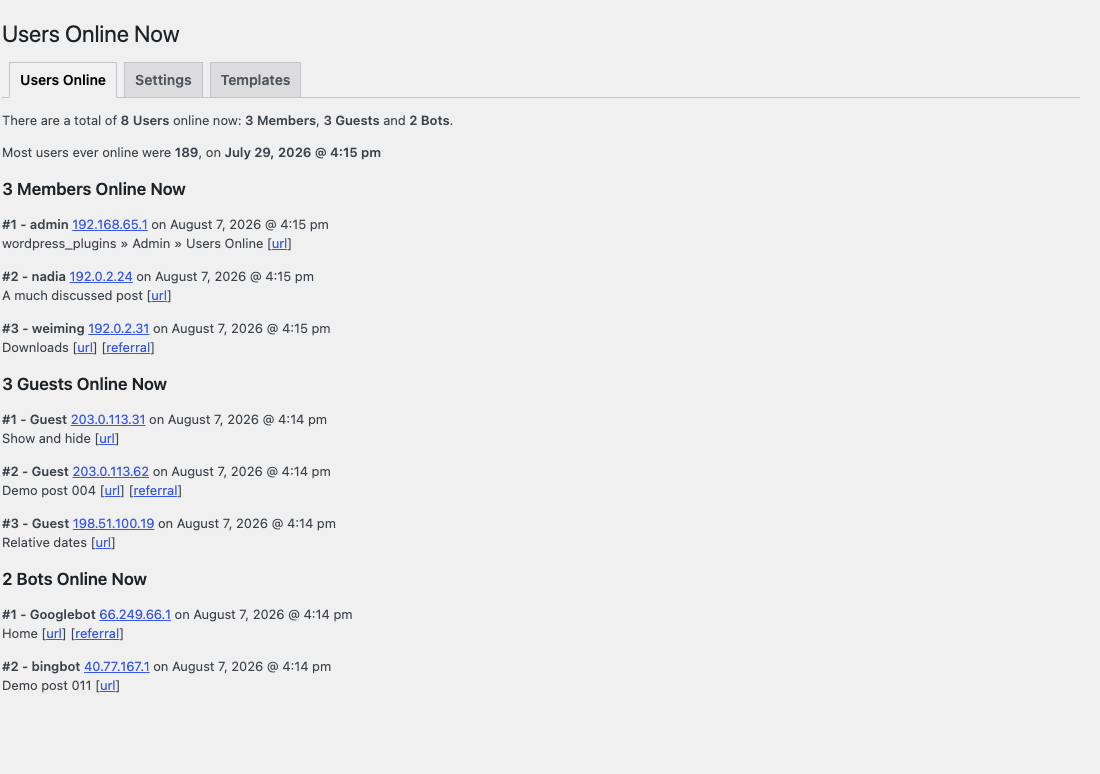
WP-UserOnline, who is on the site now, split into members, guests and bots
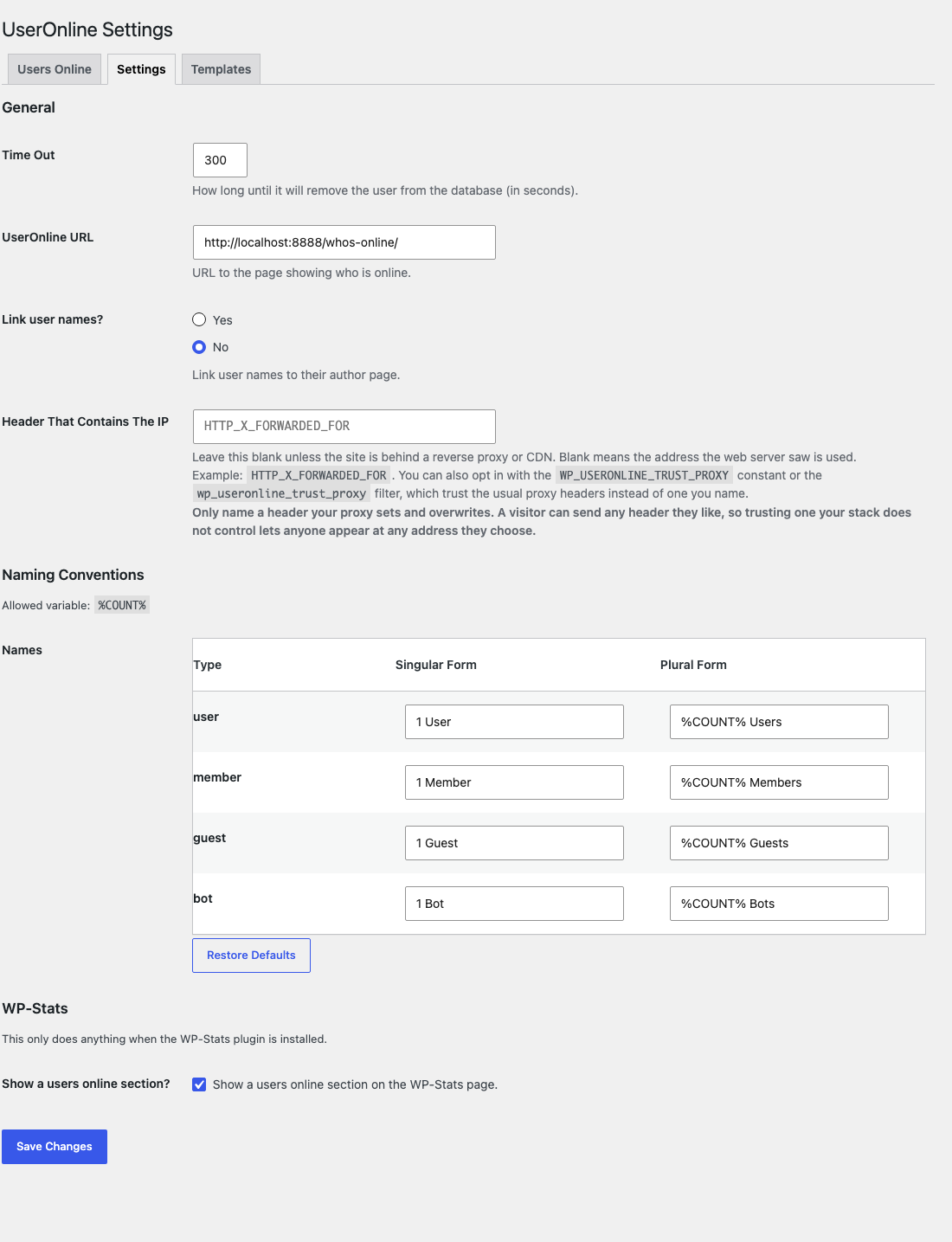
The Settings tab: the timeout, what is counted, and how a visitor is named
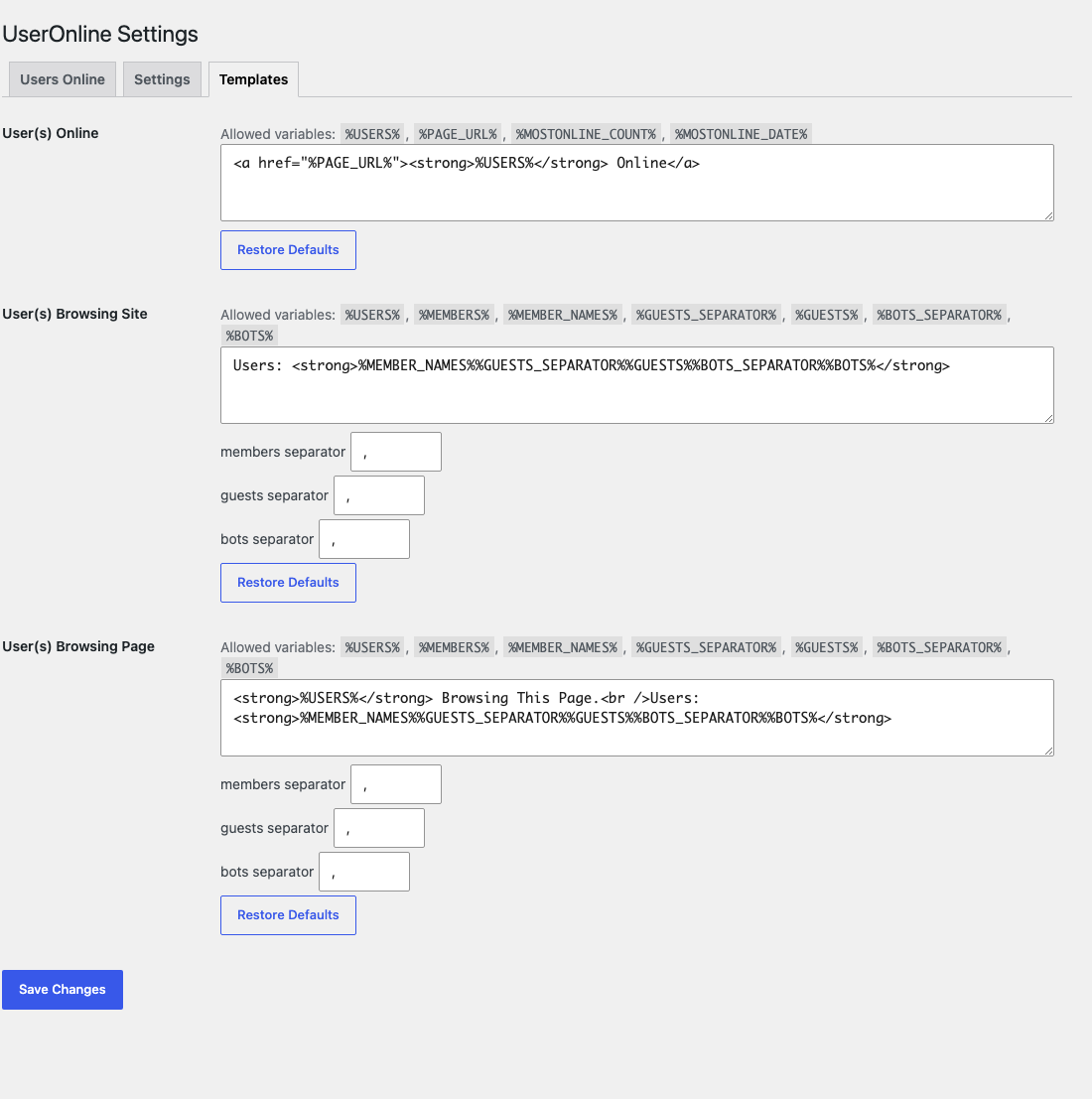
The Templates tab, holding the wording of every line the plugin prints
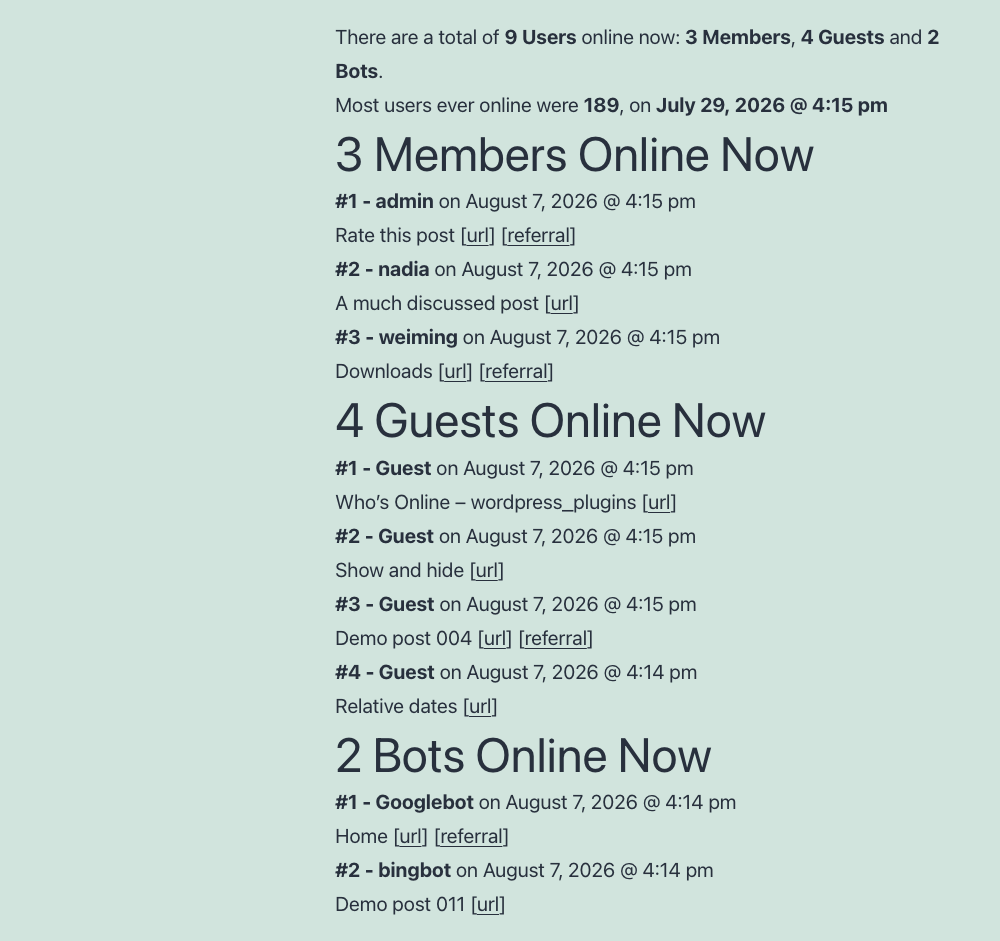
The users-online page a visitor sees, from the shortcode
Plugins semelhantes


Adiciona um campo de envio de avatares aos perfis de usuário. Gera os tamanhos necessários sob demanda, assim como o Gravatar!

WordPress user approval plugin to moderate registrations. Approve or deny real users and prevent fake signups to control who registers on site.

Member search and member directories for BuddyPress and the BuddyBoss Platform.

Online Active Users is a lightweight, powerful plugin to monitor and display how many users are currently online active on your WordPress website.

Modern Bulk Editor for Users and Profiles, create and edit hundreds of users in a spreadsheet inside wp-admin. Quick edits.
Do mesmo author (Lester Chan)

Adiciona uma interface de navegação de páginas mais avançada.

WP-Sweep allows you to clean up unused, orphaned and duplicated data in your WordPress. It also optimizes your database tables.

Enables you to display how many times a post/page had been viewed.

Manages your WordPress database.

Adds an AJAX poll system to your WordPress blog. You can also easily add a poll into your WordPress's blog post/page.

Adds an AJAX rating system for your WordPress site's content.